Mission
Artemis II overview
NASA’s first crewed Artemis flight: SLS lofted Orion from Launch Pad 39B at Kennedy Space Center, carrying four astronauts on a lunar flyby and return — a nearly 10-day mission that flew 695,081 miles in total (NASA, post-flight).
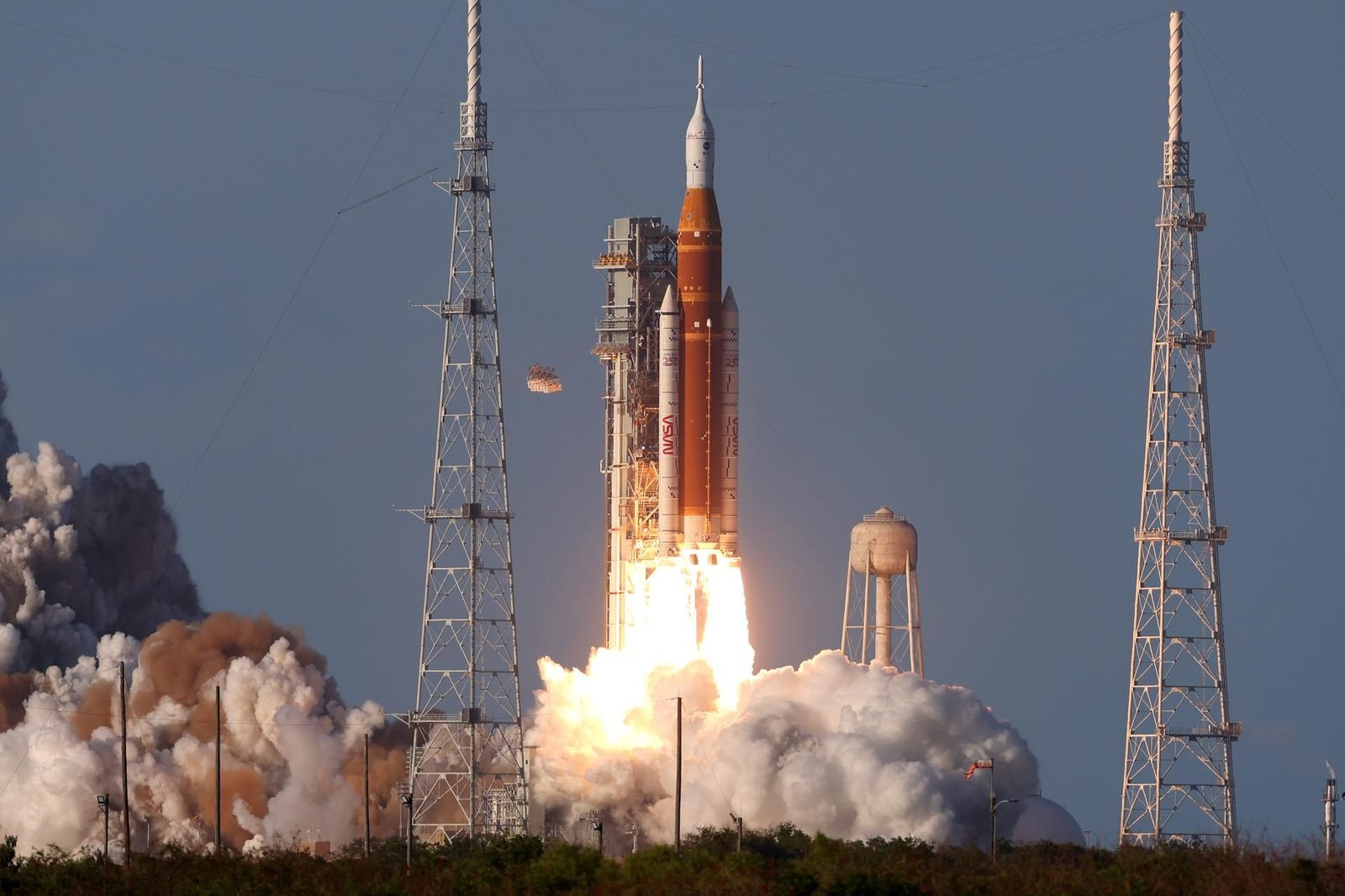 NASA / Michael DeMocker
Mission framing (NASA)
- TypeCrewed lunar flyby / systems test
- DurationNearly 10 days (NASA)
- Distance695,081 miles flown total; farthest from Earth 252,756 miles (NASA post-flight)
- LaunchPad 39B, Kennedy Space Center · 6:35 p.m. EDT, April 1, 2026 (NASA)
- SplashdownPacific Ocean off San Diego · 8:07 p.m. EDT / 5:07 p.m. PDT, April 10, 2026 (NASA)
- VehiclesSLS (Space Launch System) + Orion (crew module Integrity) + ESA European Service Module
- CrewWiseman (CDR), Glover (PLT), Koch (MS), Hansen (MS, CSA)
Timeline
Key phases
-
Launch
Liftoff from Pad 39B
SLS lofted Orion from Kennedy Space Center. NASA reported liftoff at 6:35 p.m. EDT on April 1, 2026.
-
Earth vicinity
Checkout in Earth orbit
With crew aboard, Orion and the interim cryogenic propulsion stage completed Earth orbits to verify systems while still close to home — a deliberate step beyond Artemis I’s uncrewed profile.
-
Outbound
Translunar injection
The stack departed Earth orbit onto a path that carried the crew toward and around the Moon.
-
Lunar flyby
Around the far side
The crew evaluated spacecraft performance, practiced emergency procedures, and tested the radiation shelter from a unique vantage with the Moon nearby and Earth far behind.
-
Return
Re-entry & splashdown
Orion returned through high-speed atmospheric entry and splashdown in the Pacific Ocean off San Diego. NASA reported splashdown at 8:07 p.m. EDT (5:07 p.m. PDT) on April 10, 2026.
Objectives
What success looked like
Primary goal: a crewed test flight in lunar space demonstrating that teams and systems can sustain the crew outbound, around the Moon, and home.
- Validate Orion life support, propulsion, power, thermal, and communications with crew aboard
- Practice manual operations and emergency procedures (including radiation shelter)
- Demonstrate heat shield performance and recovery operations
- Build operational confidence for Artemis III and later surface missions
Sources: NASA Artemis II, Artemis II reference / Q&A materials on nasa.gov.
Keep reading
SLS & Orion overview · Crew bios · NASA photography
Always prefer primary NASA pages if numbers differ across secondary summaries.